 Ethena
: USDe, sUSDe, and Synthetic Dollar Infrastructure
Ethena issues USDe, a synthetic dollar whose backing combines productive assets with hedges that reduce exposure to price movements. USDe targets a value close to one U.S. dollar, while sUSDe represents staked USDe and can accrue discretionary rewards. Those rewards depend on protocol revenue and distributions, so the design provides no fixed savings rate. Backing strategies span crypto basis trades, lending, liquid stablecoins, and tokenized real-world assets, with additional markets subject to approval. ENA governs protocol parameters. Secondary-market purchases, approved direct minting, and eligible staking provide different entry paths, each with its own access and liquidity conditions.
Key takeaway: sUSDe reward accrual increases the USDe value of vault shares, while their dollar value depends on USDe’s market price.
Hedged assets and the USDe dollar target
USDe’s dollar target relies on a portfolio that balances volatile backing assets with offsetting derivatives positions. Spot crypto holdings can rise or fall sharply in dollar terms. Corresponding short futures positions aim to offset price changes in volatile USDe backing assets. This pairing reduces directional exposure; it still requires functioning markets, adequate margin, and effective execution. Liquid stablecoins and short-duration dollar assets do not require the same price hedge. Their stability instead depends on underlying reserves, issuer obligations, and liquidity. Portfolio allocations change under governance and Risk Committee oversight.
Crypto basis trades pair spot holdings with perpetual or dated futures. BTC and ETH are established backing assets, while additional assets require approval. Non-crypto basis strategies extend that relationship to compatible markets, subject to instrument selection and liquidity constraints. Funding rates are periodic payments between derivative holders; dated futures can earn a basis spread. Neither revenue source promises a constant return. Overcollateralized lending and tokenized government debt or credit provide other revenue channels, whose returns depend on borrowing demand and underlying financial assets.
Approved minters can also arbitrage differences between USDe’s market price and direct issuance or redemption terms. This encourages alignment with the dollar target when access, liquidity, and execution permit.
Secondary markets and approved direct issuance
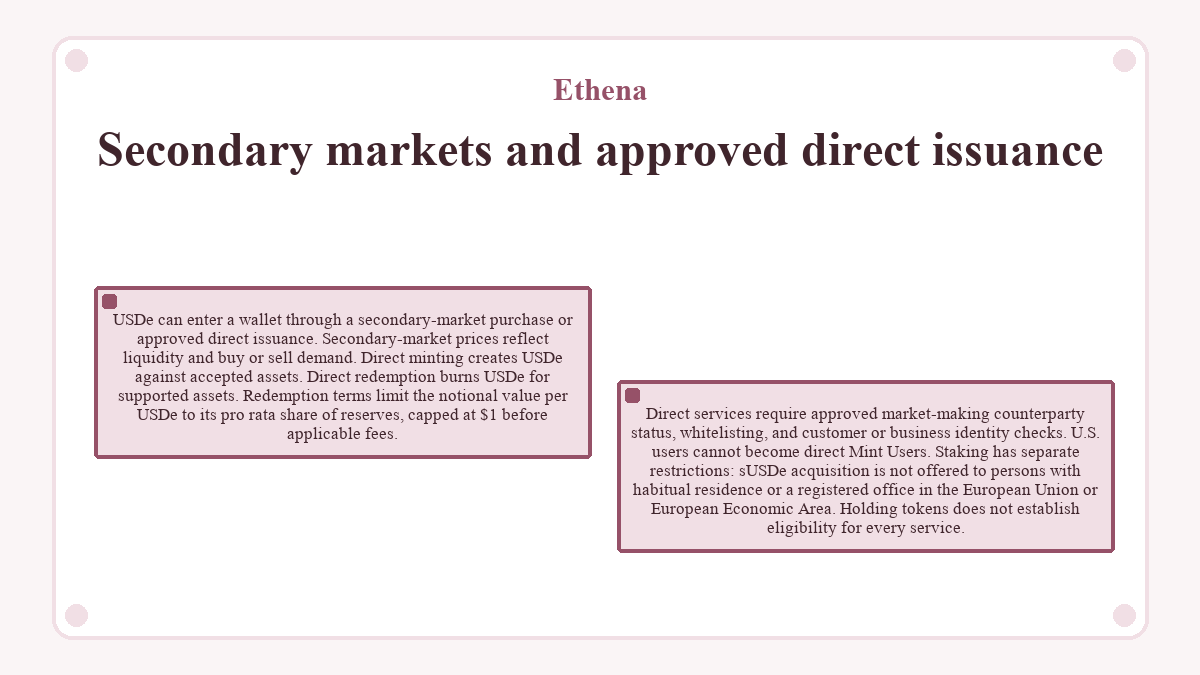
USDe can enter a wallet through a secondary-market purchase or approved direct issuance. Secondary-market prices reflect liquidity and buy or sell demand. Direct minting creates USDe against accepted assets. Direct redemption burns USDe for supported assets. Redemption terms limit the notional value per USDe to its pro rata share of reserves, capped at $1 before applicable fees. Direct services require approved market-making counterparty status, whitelisting, and customer or business identity checks. U.S. users cannot become direct Mint Users. Staking has separate restrictions: sUSDe acquisition is not offered to persons with habitual residence or a registered office in the European Union or European Economic Area. Holding tokens does not establish eligibility for every service.
sUSDe shares, rewards, and exit liquidity
sUSDe represents a proportional share of USDe held in the staking vault. The sUSDe staking contract implements the ERC-4626 token-vault standard. Depositing USDe creates vault shares, and reward deposits increase the USDe associated with each share. A holder can receive fewer sUSDe tokens than the USDe deposited without that count difference establishing a loss. USDe itself does not automatically accrue the vault’s rewards. The staked token and its underlying asset have different accounting units.
The source of savings rewards
sUSDe rewards come from discretionary distributions to the vault, funded by revenue from the backing portfolio. Funding income, lending returns, tokenized asset returns, and eligible stablecoin rewards can contribute. Ethereum staking rewards can also contribute when staked Ether forms part of the backing. The distribution rate changes with earnings, allocation decisions, and the amount staked. Rewards can remain flat during negative-revenue periods. The staking vault does not lend out deposited USDe to generate these returns.
Unstaking and secondary-market sales
Withdrawal through the staking vault
Vault unstaking converts shares into USDe and, when a cooldown applies, places that USDe in a separate holding contract. Withdrawal becomes available after the recorded cooldown ends. The active contract configuration determines the waiting period.
Sale on a trading venue
A holder can sell transferable sUSDe where a secondary market exists. This route depends on market liquidity and can price shares below the vault’s USDe conversion value.
A smaller sUSDe quote before staking
A staking quote may show fewer sUSDe tokens than the USDe input. For a USDe deposit into the sUSDe vault, the expected relationship is equivalent underlying value at the vault’s conversion rate, allowing for rounding.
- Read the deposit preview without signing a transaction to see the shares that the vault would issue.
- Compare the previewed shares with their USDe conversion value; equal token counts are unnecessary.
- Confirm staking eligibility and the active cooldown before deciding whether the withdrawal timing suits the intended use.
- Stop before authorization if the quote uses another asset or the conversion does not explain the difference.
- After a confirmed deposit, reconcile USDe transferred and sUSDe received against the rate at execution, allowing for rounding.
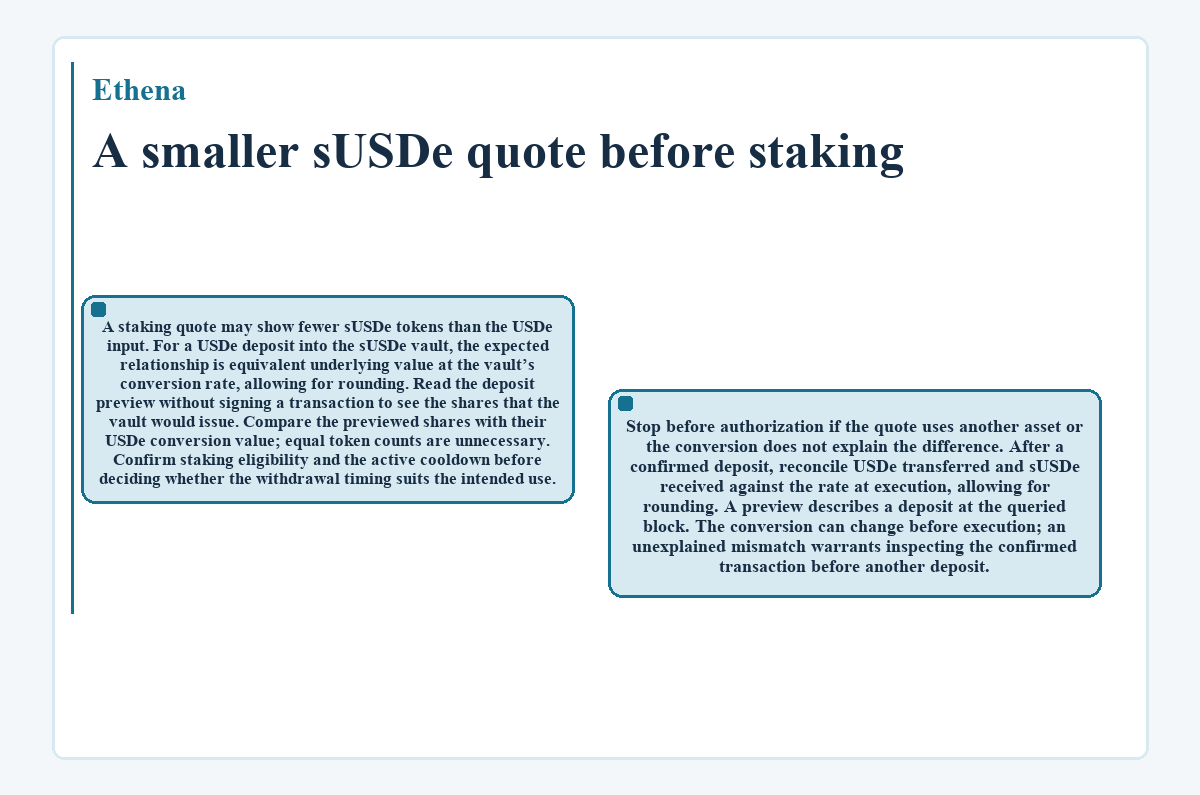
A preview describes a deposit at the queried block. The conversion can change before execution; an unexplained mismatch warrants inspecting the confirmed transaction before another deposit.
ENA governance and the separate sENA vault
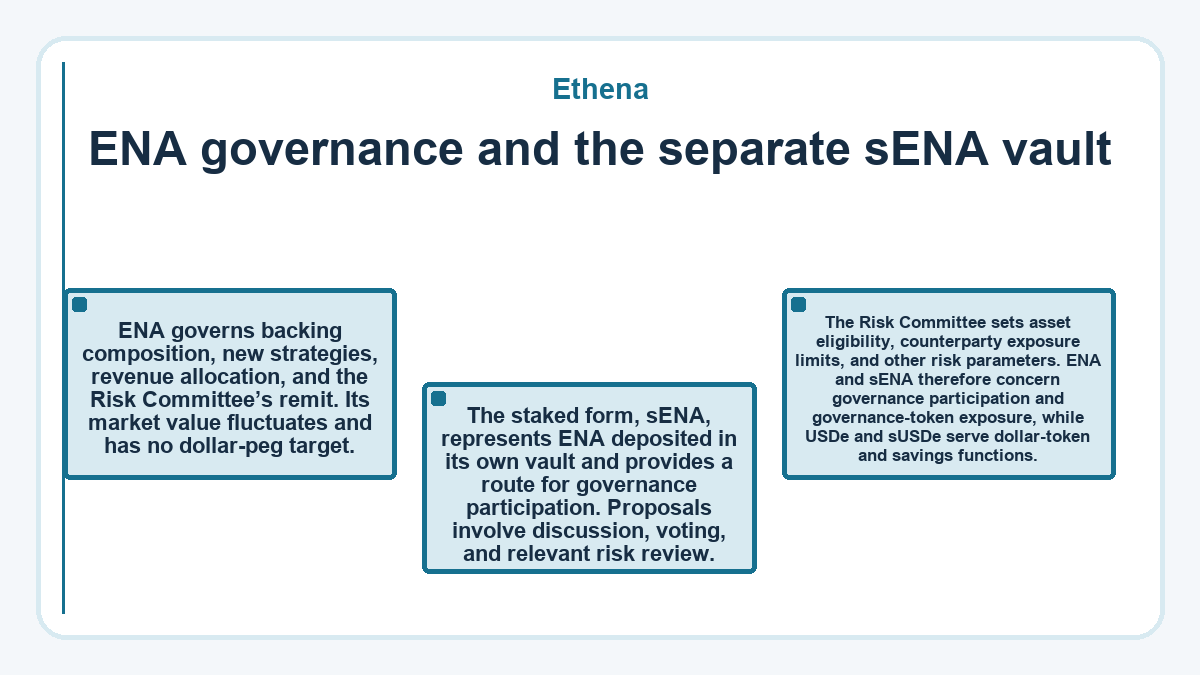
ENA governs backing composition, new strategies, revenue allocation, and the Risk Committee’s remit. Its market value fluctuates and has no dollar-peg target. The staked form, sENA, represents ENA deposited in its own vault and provides a route for governance participation. Proposals involve discussion, voting, and relevant risk review. The Risk Committee sets asset eligibility, counterparty exposure limits, and other risk parameters. ENA and sENA therefore concern governance participation and governance-token exposure, while USDe and sUSDe serve dollar-token and savings functions.
Custody dependencies, reserve buffers, and market risk
USDe remains exposed to custody, trading, and backing failures even when hedging reduces price sensitivity. Delta neutrality concerns directional market exposure. It does not remove settlement delays, counterparty default, or losses in the assets that support the token.
Custody and settlement
Off-exchange settlement providers custody the backing assets that support Ethena’s derivatives positions. Delegation lets exchanges recognize collateral while the providers retain custody. Regular settlement limits outstanding profit-and-loss exposure between settlement cycles. An exchange failure can still require replacing a hedge under stressed liquidity conditions. Custodian access problems can impede asset delegation, trading, and direct minting or redemption.
Backing mismatches and margin
Backing assets may behave differently from the instrument used to hedge them. A liquid-staking token can diverge from its underlying crypto asset’s price. That gap changes collateral coverage even if the underlying hedge remains balanced. Derivatives venues enforce margin requirements and can close positions when collateral becomes insufficient. Stablecoin depegs, lending losses, and tokenized-asset liquidity problems introduce additional risks outside ordinary crypto price movements.
Reserve capacity and contract controls
The Reserve Fund provides an additional buffer for negative aggregate revenue or backing shortfalls. Its capacity depends on available assets and the size and duration of losses. sUSDe reward accounting can remain flat during negative-revenue periods while USDe’s traded dollar price falls. Contract permissions also matter: authorized operators can change relevant parameters, pause direct issuance services, restrict sUSDe access under documented sanctions or legal conditions, and redistribute sUSDe from fully restricted wallets. A staking restriction is distinct from a general freeze of USDe transfers.
Dashboard backing data and custodian attestations address asset coverage. They do not demonstrate an uninterrupted dollar market price or immediate liquidity during a stressed exit.
USDtb, branded stablecoins, and payments
USDtb has a different reserve design within the wider product ecosystem. Its model uses tokenized U.S. Treasury-fund backing alongside liquid reserves. Anchorage Digital Bank handles its issuance, redemption, and reserve management. Ethena Whitelabel supplies infrastructure for branded stablecoins, including issuance, custody, backing operations, and integrations. Partners can select approved backing combinations involving USDe, USDtb, or other supported stablecoins. Their product terms determine holder eligibility, reward arrangements, and redemption conditions. A branded token’s backing composition remains a separate question from the mechanics of sUSDe.
Ethena Pay packages dollar balances, transfers, and card spending in a separate money app. Feature eligibility depends on jurisdiction and product terms; its Spend Card excludes U.S. persons. Promotional rewards carry additional conditions, including eligible balances and qualifying activity. A savings position turns on eligibility for sUSDe and whether vault withdrawal or a secondary-market sale suits the required timing.
Frequently asked questions about Ethena
Which costs can apply when acquiring or redeeming USDe?
USDe transaction costs depend on whether you trade on a secondary market or use approved direct issuance services. Direct minting and redemption quotes can include hedge execution costs and slippage, alongside blockchain transaction costs. A trading venue can charge its own fees and impose a spread. These costs belong to the selected transaction path; a staking reward percentage does not describe the cost of entering or exiting USDe.
How can sUSDe APY figures differ between platforms?
sUSDe annual percentage yield (APY) figures can differ because platforms use different observation periods and compounding assumptions. Reward distributions also relate to an earlier earning period, while the amount staked can change before those distributions arrive. A short interval extrapolated into a year can therefore differ from a weekly calculation. The displayed figure describes an annualized reward calculation, and it does not fix the return over the following year.
Are wallet-held USDe balances covered by deposit insurance?
Wallet-held USDe balances are not covered by government deposit insurance. The Reserve Fund uses available protocol assets to address shortfalls; it does not create an insured bank deposit for token holders. This remains true when regulated custodians or banking institutions participate in reserve arrangements.
Can Ethena reverse a USDe transfer sent to the wrong address?
Ethena cannot reverse or recall a completed USDe blockchain transfer. If the recipient controls the destination, returning the tokens requires that recipient’s cooperation. A mistyped address or a lost private key can leave the balance inaccessible. A transfer record shows where tokens moved, but it does not give the issuer control of the destination wallet or create a recovery right.
Does a USDe wrapper carry the same direct redemption rights as USDe?
A third-party USDe wrapper does not automatically carry the issuer’s support or direct redemption access. Its mechanics and any claim on underlying USDe depend on the wrapper’s own design. Direct USDe redemption still requires approved Mint User status and satisfaction of the applicable terms. A wrapper’s name or ticker cannot establish those rights, and an unsupported copy may operate independently of the genuine token.